

How Can an Intelligent Packaging Line Series Help Manufacturers Reduce Labor Pressure and Improve Delivery Reliability?
2026-04-23
When I look at the daily pressure inside a modern factory, I do not just see products moving from one station to another. I see missed handoffs, rising labor costs, uneven packaging quality, avoidable material waste, and the constant risk of delayed shipment. That is exactly why companies like Guangdong Fortran Machinery Co.,ltd. keep becoming part of real production conversations. As manufacturers search for a more connected and dependable way to package finished goods, the value of an Intelligent Packaging Line Series becomes much easier to understand in practical terms rather than in marketing slogans.
I have noticed that many buyers are not looking for a machine in isolation. They are trying to solve a chain problem. They want products to move smoothly, measurements to stay accurate, packaging steps to remain consistent, and outbound logistics to stop depending so heavily on manual coordination. That is where a well-planned Intelligent Packaging Line Series stands out. Instead of treating packaging as the final and often messy step, it turns packaging into a controlled and connected part of the production system.
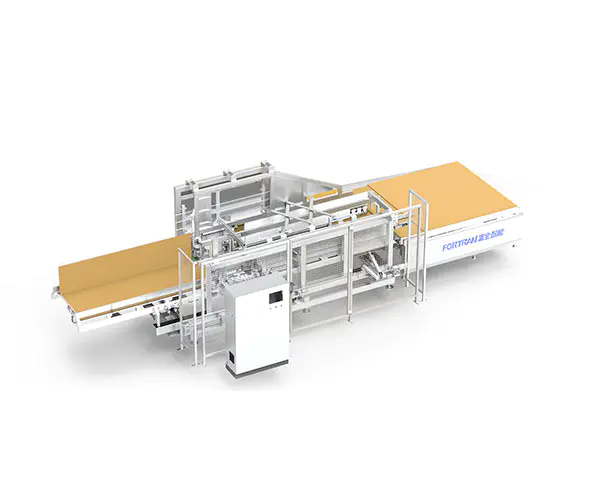
Why Do So Many Packaging Bottlenecks Start Before the Final Packing Step?
In many plants, the visible problem appears at the end of the line, but the real issue begins earlier. I often see packaging delays caused by unstable upstream flow, inconsistent product positioning, poor data handoff, or operators having to compensate for gaps between single machines. When these weak points pile up, the final packaging area becomes overloaded.
The result is familiar to almost every factory manager:
- Finished products arrive in irregular batches
- Operators spend too much time aligning, sorting, and rechecking items
- Packaging material usage becomes difficult to control
- Damage risk increases during transfer and stacking
- Shipping schedules become harder to predict
This is why I do not evaluate an Intelligent Packaging Line Series only by asking how fast one machine runs. I look at how well the entire line connects transport, measurement, alignment, packaging, and discharge. If those stages communicate properly, the line does more than save labor. It reduces production friction.
What Makes an Intelligent Packaging System More Useful Than a Group of Standalone Machines?
A standalone machine may perform one task very well, but factories rarely struggle because one function is missing. More often, they struggle because each function sits in its own island. I have found that the real advantage of an integrated packaging line is continuity. Products do not stop and wait for people to rescue the process at every transition point.
That difference matters in several ways:
- Material flow becomes more predictable from production to dispatch
- Packaging quality becomes easier to standardize across shifts
- Adjustment time can be reduced when production specifications change
- Supervisors gain a clearer view of output rhythm and bottlenecks
- Manual handling can be cut down, which helps both efficiency and product protection
When I discuss equipment planning with buyers, I usually remind them that the best packaging investment is not the one with the longest feature list. It is the one that makes the line easier to run every day. A practical Intelligent Packaging Line Series supports that goal by linking critical steps so the operation feels like one process instead of several disconnected tasks.
How Can Buyers Tell Whether a Packaging Line Really Matches Their Factory Conditions?
This is one of the most important questions, because a packaging line that looks impressive on paper may still perform poorly on site. I always suggest starting with production reality rather than product brochure language. A serious evaluation should include product dimensions, throughput targets, floor layout, transfer distance, packaging standards, labor arrangement, and future expansion needs.
Here is the kind of comparison I use when reviewing packaging line fit:
| Evaluation Point | What I Check | Why It Matters |
|---|---|---|
| Factory Layout | Available floor space, turning radius, entry and exit direction | Prevents line congestion and awkward product flow |
| Output Demand | Daily capacity, peak shift volume, batch variation | Helps match line speed to real operating pressure |
| Product Characteristics | Size, thickness, weight, surface sensitivity | Reduces handling damage and packaging mismatch |
| Labor Structure | Current manpower, skill level, turnover rate | Shows where automation can deliver the fastest return |
| Packaging Consistency | Accuracy of measuring, folding, sealing, stacking | Improves shipment quality and customer satisfaction |
| Adjustment Efficiency | Time needed for size changes and process switching | Supports flexible production without heavy downtime |
If a supplier can discuss these points clearly, I pay attention. It usually means they understand that an Intelligent Packaging Line Series should be adapted to the site, not forced onto it.
Which Problems Can an Intelligent Packaging Line Solve for Furniture and Panel Processing Plants?
For furniture makers, panel processors, and similar manufacturers, the packaging stage often carries more risk than it seems. The product is already finished, so every scratch, wrong count, unstable stack, or poor seal directly affects the value of the shipment. That is why packaging cannot stay as a rough manual ending to a precise manufacturing process.
In this type of environment, I usually see several recurring pain points:
- Boards or finished components arrive unevenly from upstream equipment
- Manual measuring slows down output and increases inconsistency
- Packaging materials are used inefficiently because dimensions vary
- Workers spend too much time lifting, rotating, or repositioning products
- Finished packages are harder to move safely to storage or shipping
A coordinated Intelligent Packaging Line Series helps by building order into that last stage. It can support smoother transfer, cleaner process linking, more stable package formation, and better handling logic before shipment. For factories that need reliable throughput rather than occasional bursts of speed, that stability is often more valuable than headline machine speed alone.
What Product Advantages Matter Most When I Evaluate Long Term Operating Value?
I care less about flashy wording and more about whether the line improves the operating math over time. In my experience, the strongest product advantages usually show up in daily repetition. If the system saves a little labor, avoids a little waste, and prevents a little downtime every shift, that adds up fast.
The most meaningful advantages usually include:
- Higher automation that lowers dependence on repetitive manual work
- More stable flow between single machines and packaging stations
- Faster line adjustment when product specifications change
- Cleaner transport and handling that helps protect product surfaces
- Better control of packaging material use and operating cost
- Smoother line coordination that supports predictable delivery schedules
I also pay attention to maintainability. A line that performs well only when senior technicians are nearby is not really solving a factory problem. A useful system should be understandable, practical to operate, and easier to keep running under normal production pressure. That is one reason buyers continue to look closely at solutions built around an Intelligent Packaging Line Series instead of relying on scattered manual fixes.
Is Lower Labor Dependence the Only Reason to Upgrade Packaging Equipment?
Not at all. Labor reduction is important, but it is only one part of the decision. I have seen factories upgrade because they needed better shipment consistency, fewer packaging complaints, improved material control, or a cleaner handoff between production and logistics. In other words, the real question is not whether fewer workers are needed. The real question is whether the factory can run with fewer disruptions.
This broader view is useful:
| Business Goal | Traditional Manual Packaging Risk | Integrated Line Benefit |
|---|---|---|
| Cut operating cost | High labor input and rework | More repeatable process and lower manual dependence |
| Protect product quality | Frequent mishandling and uneven stacking | More controlled transfer and packaging sequence |
| Improve delivery accuracy | Unstable end-of-line rhythm | More predictable packaging throughput |
| Support expansion | Manual flow becomes a bottleneck | Better scalability through linked equipment logic |
| Reduce waste | Inconsistent measuring and material use | Stronger control over packaging execution |
That is why I see the upgrade decision as strategic. An Intelligent Packaging Line Series is not only about replacing labor. It is about making production output easier to convert into shippable, consistent, and commercially reliable packages.
How Should I Choose a Supplier Without Falling for Generic Sales Language?
I usually ask simple but revealing questions. Can the supplier discuss layout constraints in detail? Can they explain how the line adapts to production capacity and product characteristics? Can they describe how separate machines are linked for smoother transitions? Can they talk about after-sales support in practical terms rather than empty promises?
Those questions matter because a packaging line affects real workflows, not just procurement paperwork. I want a supplier that understands application logic, not one that simply lists machine names. If a manufacturer can connect transport, measuring, cutting, folding, sealing, stacking, and discharge into a sensible process story, that is a much better sign than exaggerated branding language.
For that reason, I believe buyers should look for a supplier that treats packaging as part of the full manufacturing chain. That approach gives an Intelligent Packaging Line Series real business value instead of leaving it as a collection of isolated machines.
What Should I Do If I Want a Packaging Solution That Fits My Production Goals Better?
If you are dealing with unstable packaging output, rising labor pressure, inconsistent package quality, or a line that still depends too much on manual coordination, now is the right time to review your process more seriously. I would start by mapping your current flow, identifying where delays and handling risks appear, and comparing those weak points against what an integrated packaging solution could improve.
If you want to explore a more practical path forward, this is worth discussing with a supplier that understands line coordination, transport logic, and packaging efficiency in a real factory environment. Guangdong Fortran Machinery Co.,ltd. is active in this field, and if you are evaluating a suitable Intelligent Packaging Line Series for your plant, this is the moment to move from general interest to a direct project conversation. Please contact us for product details, line planning support, and tailored recommendations based on your layout, output target, and packaging requirements.
