

How Does a Glass Bottle Filling Machine Improve Filling Accuracy and Production Efficiency?
2026-08-25
Article Summary: A modern glass bottle filling machine does much more than transfer liquid into containers. It must coordinate accurate dosing, stable bottle positioning, hygienic product handling, sealing, and efficient production while minimizing product loss and glass breakage. For beverage, condiment, dairy, sauce, juice, and other liquid-processing manufacturers, choosing the right filling technology can directly affect product consistency, operating costs, sanitation, and overall production reliability. This guide explains how a glass bottle filling machine works, which technical factors matter most, how to solve common filling problems, and what buyers should evaluate before investing in equipment.
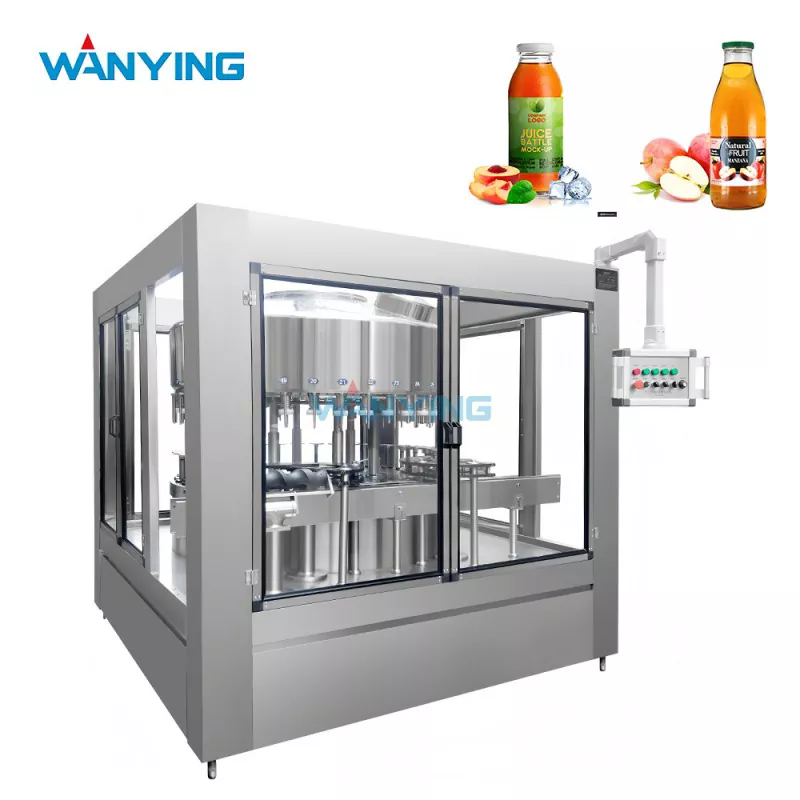
Table of Contents
- Article Outline
- Why Glass Bottle Filling Requires Specialized Equipment
- How a Glass Bottle Filling Machine Works
- Key Stages of the Filling Process
- How to Match Filling Technology With Product Characteristics
- Common Glass Bottle Filling Problems and Practical Solutions
- Important Features to Evaluate Before Purchase
- Glass Bottle Filling Machine Configuration Comparison
- Applications Across Different Industries
- Maintenance and Hygiene Practices
- Why Consider Hubei Wanying Machinery Co., Ltd.
- What Should Buyers Check Before Ordering?
- Frequently Asked Questions
- Conclusion
Article Outline
- Understand the specific challenges associated with glass containers.
- Learn the basic operating principle of a glass bottle filling machine.
- Identify the most important filling parameters for different liquids.
- Compare suitable filling approaches according to viscosity, temperature, particles, and carbonation.
- Reduce filling errors, bottle breakage, contamination, dripping, and unnecessary product loss.
- Evaluate machine construction, controls, changeover, sanitation, and after-sales support before purchase.
Why Glass Bottle Filling Requires Specialized Equipment
Glass remains an important packaging material for many products because it offers excellent chemical stability, strong barrier properties, a premium appearance, and good compatibility with a wide range of beverages and food products. However, glass containers also create challenges that are not present to the same degree with flexible packaging or plastic bottles.
A glass bottle can vary in diameter, height, neck design, wall thickness, and overall geometry. It is also considerably more fragile than many plastic containers. During high-speed production, poor positioning or excessive mechanical force can lead to bottle cracks, breakage, liquid spills, and unplanned downtime.
The filling system therefore needs to balance three objectives: accuracy, gentle handling, and production stability.
Filling accuracy is particularly important because an underfilled container may create compliance and customer-perception problems, while excessive filling increases material costs. At the same time, the filling process must protect the product from unnecessary contamination and maintain the intended characteristics of the liquid.
Modern glass bottle filling equipment can combine filling with other processes such as bottle conveying, sealing, foil application, or capping. Depending on the production line, the machine may operate independently or become part of a more comprehensive automated packaging system.
How a Glass Bottle Filling Machine Works
The operating principle depends on the liquid being packaged, but the overall production sequence follows a relatively clear pattern.
- Bottle feeding: Empty glass bottles are transferred into the filling area through a controlled conveying and positioning system.
- Bottle positioning: Guides, star wheels, clamps, or centering mechanisms stabilize each bottle before filling.
- Filling: The selected filling valve or dosing system introduces a controlled quantity of liquid into the bottle.
- Level or volume control: Sensors, flow meters, volumetric mechanisms, or other control methods help maintain consistent filling.
- Drip prevention: The filling nozzle is withdrawn or closed in a controlled manner to reduce residual liquid around the bottle neck.
- Sealing or capping: Depending on the packaging specification, the bottle may receive a screw cap, foil seal, crown closure, or another closure.
- Discharge: Filled and sealed bottles leave the machine and continue toward labeling, inspection, packaging, or palletizing.
For carbonated products, the filling principle is different from that used for many still liquids. Counter-pressure filling can be used to establish suitable pressure conditions between the bottle and product tank before liquid transfer, helping control foaming and carbonation loss. For still products, gravity, volumetric, flow-meter, piston, or other filling approaches may be more appropriate.
The correct principle should therefore be selected according to the actual product rather than simply choosing a machine based on its nominal speed.
Key Stages of the Filling Process
1. Bottle Infeed and Positioning
Stable bottle handling is the foundation of reliable filling. If bottles enter the filling station at inconsistent positions, even a highly accurate dosing system may produce poor results.
Proper guides and positioning components help maintain the bottle centerline and reduce collisions. This is particularly important for lightweight, narrow-neck, square, oval, or custom-shaped glass bottles.
2. Controlled Liquid Dosing
The filling system determines how much liquid enters each container. Different products require different approaches because viscosity, temperature, particulate content, and foaming characteristics affect liquid behavior.
Low-viscosity liquids may flow easily through conventional filling valves, while sauces and pulpy beverages may require larger passages or specialized pumping systems. A filling solution should be tested with the actual product whenever possible.
3. Filling Speed Management
Simply increasing filling speed does not always increase usable production output. Excessive flow velocity can create turbulence, splashing, foaming, dripping, or unstable liquid levels.
A better approach is to control the filling profile according to the product. Some applications benefit from a slower initial stage followed by faster filling and a controlled finishing stage. This allows production speed and filling quality to be balanced.
4. Sealing and Capping
Once the correct quantity of liquid has been introduced, the bottle must be closed properly. An effective filling line should coordinate filling and closure operations so that bottles are not exposed unnecessarily after filling.
Depending on the product and packaging design, sealing may involve aluminum foil, screw caps, crown closures, or other closure technologies.
How to Match Filling Technology With Product Characteristics
One of the most common purchasing mistakes is selecting filling equipment based only on bottle volume or production speed. The liquid itself is equally important.
| Product Type | Typical Filling Consideration | Main Production Concern |
|---|---|---|
| Water and other thin liquids | Gravity, volumetric, or flow-controlled filling | Fill consistency and hygiene |
| Fruit juice | Suitable valve and controlled filling | Pulp handling and sanitation |
| Carbonated beverages | Counter-pressure/isobaric filling | Foam and CO₂ retention |
| Milk and liquid dairy products | Hygienic controlled filling | Sanitation and product integrity |
| Soy sauce and vinegar | Corrosion-resistant product-contact components | Dripping and corrosion |
| Oyster sauce and viscous sauces | Piston, pump, or specialized filling valves | Viscosity and valve passage |
| Pulpy or particulate products | Large-passage or specialized filling system | Clogging and particle distribution |
The product temperature should also be considered. Some juice and food applications use hot filling, which means the machine must be designed for the corresponding thermal conditions. Glass containers can also be sensitive to rapid temperature changes, so bottle handling and thermal management should be considered together.
Common Glass Bottle Filling Problems and Practical Solutions
Problem 1: Inconsistent Fill Levels
Uneven filling can originate from unstable liquid pressure, incorrect valve settings, inaccurate dosing, bottle-position variation, or changes in product viscosity.
Solution: Verify the filling principle, stabilize the product supply, calibrate the dosing system, and confirm that every bottle is correctly positioned under the filling head.
Problem 2: Liquid Dripping Around the Bottle Neck
Dripping can contaminate labels and closures, increase product waste, and make the finished package look unprofessional.
Solution: Select an appropriate anti-drip valve, optimize filling and shutoff timing, and ensure that the nozzle geometry matches the bottle neck and product characteristics.
Problem 3: Glass Bottle Breakage
Bottle breakage can stop production and create a significant safety concern. Common causes include excessive mechanical impact, poor alignment, unsuitable star-wheel settings, bottle defects, and excessive thermal stress.
Solution: Use controlled bottle transfer, appropriate guides, correct bottle spacing, suitable positioning components, and carefully managed temperature changes.
Problem 4: Filling Valve Clogging
Pulp, fibers, particles, and high-viscosity liquids can obstruct narrow passages.
Solution: Use valves and product passages designed for the actual particle size and viscosity. Regular cleaning is also essential, especially when the product contains suspended solids.
Problem 5: Excessive Production Downtime
Frequent cleaning, difficult changeovers, and complicated maintenance procedures can reduce actual production capacity even when the machine's theoretical speed is high.
Solution: Look for modular components, accessible filling heads, recipe management, quick-change parts, and a maintenance strategy designed around the real production schedule.
Important Features to Evaluate Before Purchase
A reliable glass bottle filling machine should be evaluated as a complete production system rather than as a collection of individual components.
- Filling accuracy: Confirm the expected accuracy under actual operating conditions.
- Bottle compatibility: Check bottle diameter, height, neck dimensions, shape, and weight.
- Product compatibility: Evaluate viscosity, temperature, particles, acidity, foaming, and other characteristics.
- Hygienic construction: Product-contact surfaces should be appropriate for the intended food or beverage application.
- Cleaning accessibility: Filling valves and product-contact components should be easy to inspect and clean.
- Changeover capability: Consider how quickly operators can switch between bottle sizes and products.
- Control system: A clear HMI and programmable control system can simplify recipe management and troubleshooting.
- Safety: Guards, emergency stops, sensors, and controlled bottle handling are essential for industrial operation.
- Integration: The machine should be compatible with upstream washing and downstream capping, labeling, inspection, and packaging equipment.
- After-sales support: Installation, commissioning, spare parts, training, and technical assistance can significantly influence long-term operating costs.
Glass Bottle Filling Machine Configuration Comparison
| Configuration | Suitable Application | Key Advantage | Important Consideration |
|---|---|---|---|
| Standalone filler | Small or flexible production | Lower initial complexity | Requires coordination with other machines |
| Filler and capper combination | Continuous liquid packaging | Reduced manual handling | Closure compatibility must be verified |
| Rinser-filler-capper system | Beverage production | Integrated bottle processing | Requires coordinated utilities and layout |
| Custom automated line | Medium and large-scale production | High automation and process continuity | Higher project planning requirements |
The appropriate configuration depends on production volume, available floor space, labor resources, product portfolio, bottle specifications, and future expansion plans.
Applications Across Different Industries
Glass bottle filling technology is not limited to traditional beverage production. Different filling configurations can support a wide variety of liquid and semi-liquid products.
- Beverages: Water, fruit juice, tea, functional drinks, and selected carbonated beverages.
- Condiments: Soy sauce, vinegar, cooking sauces, dressings, and other liquid seasonings.
- Dairy products: Milk and selected liquid nutritional products requiring controlled hygienic handling.
- Health and functional liquids: Products where accurate dosing and controlled sanitation are important.
- Pickled foods: Brines and liquid components used with fermented or preserved foods.
- Specialty liquids: Applications requiring custom bottle handling or product-specific filling valves.
The key requirement is not simply whether the machine can physically fill a bottle. The entire product-contact pathway must be compatible with the liquid, temperature, viscosity, particles, and sanitation requirements.
Maintenance and Hygiene Practices
Even a well-designed machine will lose performance if maintenance is neglected. Preventive maintenance should be incorporated into the production schedule rather than performed only after a failure occurs.
- Inspect filling valves and seals regularly for wear.
- Clean product-contact surfaces according to the product's sanitation requirements.
- Check sensors and bottle-positioning components for contamination or misalignment.
- Inspect pumps, hoses, valves, and connections for leakage.
- Verify filling accuracy periodically using an appropriate calibration procedure.
- Inspect electrical cabinets and pneumatic systems according to the manufacturer's maintenance recommendations.
- Keep critical spare parts available for components with predictable wear.
- Record recurring faults to identify the root cause instead of repeatedly treating symptoms.
For food and beverage production, cleaning is especially important. Residual product can become a contamination source, while dried sauce, pulp, sugar, or other materials can interfere with valve operation.
Why Consider Hubei Wanying Machinery Co., Ltd.
Hubei Wanying Machinery Co., Ltd. provides glass bottle filling solutions designed around the characteristics of the product and bottle rather than relying on a universal configuration.
The company's glass bottle filling equipment is designed for glass containers in the approximately 0.3–2 L range, with configurations supporting applications including juice, dairy products, condiments, sauces, and other liquid or semi-liquid products. The product information indicates filling accuracy of up to ±0.3% and production capacity reaching approximately 2,500 bottles per hour, depending on the specific configuration and operating conditions.
Wanying's approach also emphasizes customization. Bottle dimensions, filling nozzle configuration, product characteristics, filling requirements, and production targets can all influence equipment design. This is particularly valuable for manufacturers using unusual bottle shapes or products with challenging viscosity and particulate characteristics.
The company also describes solutions incorporating filling, foil sealing, and capping functions, allowing equipment to serve either as a standalone machine or as part of a more comprehensive automated production line.
For buyers evaluating equipment, this type of engineering approach can be valuable because the machine should be matched to the actual production process rather than selected solely from a catalog capacity figure.
What Should Buyers Check Before Ordering?
Before requesting a quotation, prepare detailed information about your production requirements. Providing accurate technical data allows the manufacturer to recommend a more suitable configuration.
- What liquid or semi-liquid product will be filled?
- What are the product's viscosity and temperature ranges?
- Does the product contain pulp, fibers, particles, or suspended solids?
- Is the product carbonated or non-carbonated?
- What are the bottle dimensions and neck specifications?
- What bottle volumes are required?
- What production capacity is required in bottles per hour?
- What type of closure will be used?
- Is hot filling required?
- How frequently will the product or bottle format change?
- Will the machine operate independently or as part of a complete production line?
- What are the available electrical, water, compressed-air, and floor-space conditions?
It is also worthwhile to ask for performance testing using your actual product and bottles. Laboratory or factory testing can reveal issues involving viscosity, foaming, filling speed, bottle stability, valve selection, and cleaning before the equipment reaches the production floor.
Frequently Asked Questions
Q1: What products can a glass bottle filling machine handle?
A glass bottle filling machine can be configured for many liquids and semi-liquids, including water, juice, dairy products, sauces, soy sauce, vinegar, cooking oil, brines, and selected health or functional liquids. The correct filling valve and dosing method depend on the product characteristics.
Q2: Can a glass bottle filling machine handle viscous products?
Yes. High-viscosity products may require piston fillers, specialized pumps, larger product passages, or customized filling valves. The machine should be selected after evaluating the actual viscosity and flow characteristics of the product.
Q3: How can bottle breakage be reduced?
Bottle breakage can be reduced through accurate positioning, gentle transfer mechanisms, suitable guides, correct bottle spacing, controlled filling pressure, and appropriate management of temperature changes. Bottle quality and dimensional consistency should also be considered.
Q4: How important is filling accuracy?
Filling accuracy directly affects product giveaway, package consistency, customer perception, and production control. Even a small filling error becomes significant when multiplied across thousands of bottles.
Q5: Can the machine be customized for unusual glass bottles?
Customization is possible with appropriately engineered equipment. Bottle dimensions, neck geometry, bottle shape, positioning method, filling nozzle size, and transfer components may all need to be adapted for non-standard containers.
Q6: Can the filling machine become part of an automated production line?
Yes. Depending on the configuration, a glass bottle filling machine can be integrated with bottle washing, conveying, capping, labeling, inspection, packaging, and other upstream or downstream equipment.
Q7: What should be considered when filling hot products?
Hot filling requires attention to product temperature, material compatibility, sealing performance, thermal stability, and bottle handling. Rapid temperature changes should be controlled to reduce thermal shock and glass breakage.
Q8: How can manufacturers reduce filling downtime?
Choose equipment with accessible product-contact components, practical changeover procedures, reliable sensors and controls, easy-to-maintain valves, and readily available spare parts. Operator training and preventive maintenance are equally important.
Conclusion
A Glass Bottle Filling Machine is a critical component of a reliable liquid packaging operation. The right machine must do more than achieve a target bottles-per-hour figure. It must maintain consistent filling accuracy, protect fragile glass containers, accommodate the physical characteristics of the product, support hygienic production, and integrate effectively with the rest of the packaging line.
The most reliable purchasing strategy is to begin with the product and bottle specifications, then determine the appropriate filling technology, valve design, control system, bottle-handling mechanism, and automation level. Buyers should also consider changeover time, cleaning accessibility, maintenance requirements, spare parts, commissioning, and technical support.
For manufacturers looking for a customized solution, Hubei Wanying Machinery Co., Ltd. can provide glass bottle filling equipment designed around specific bottle formats, products, and production requirements. A carefully matched filling system can help reduce product waste, improve package consistency, simplify operation, and create a more dependable production process.
Ready to improve your glass bottle filling process? Share your product type, bottle size, filling volume, required capacity, and production requirements with Hubei Wanying Machinery Co., Ltd. to discuss a suitable configuration and contact us for a customized glass bottle filling solution.
