

How Does Valve Mouth Paper Bag Protect Gypsum Powder During Shipping?
2026-09-18
1. What Damage Risks Does Gypsum Powder Face During Shipping?
Gypsum powder faces four specific damage risks during shipping. The first is moisture absorption. Gypsum is hygroscopic; it absorbs water vapor from the air. When it absorbs moisture, it can cake, lose its flowability, and in some cases begin to set prematurely. The second is bag rupture. The fine powder creates internal pressure during filling and handling. If the bag is not strong enough, it can burst at the seams or the valve. The third is dust leakage. Even a small gap in the valve or the seams allows powder to escape. This creates product loss and a contamination hazard. The fourth is stack collapse. Bags that are not designed for the correct stacking height can deform and fall, causing damage to the product and the packaging.
The table below shows the risk factors and the corresponding bag design features that address them.
| Damage risk | Cause | Bag design feature | Verification test |
| Moisture absorption | Humidity during transport | PE coating or PE liner | WVTR test |
| Bag rupture | Internal pressure, handling impact | High-strength kraft paper, reinforced seams | Drop test, compression test |
| Dust leakage | Poor valve seal | Self-sealing valve with internal flap | Valve leakage test |
| Stack collapse | Insufficient stacking strength | Correct paper grammage and bag construction | Compression test |
Wenzhou Chenxing Packaging Co., Ltd. has been manufacturing Valve Mouth Paper Bag units for over 15 years. Our factory produces bags that are specifically designed for gypsum powder and other fine mineral powders. We use a combination of high-strength kraft paper, PE coating, and a precision-formed valve to achieve the protection required for long-distance shipping.
2. How Does the Valve Mouth Mechanism Prevent Dust Leakage?
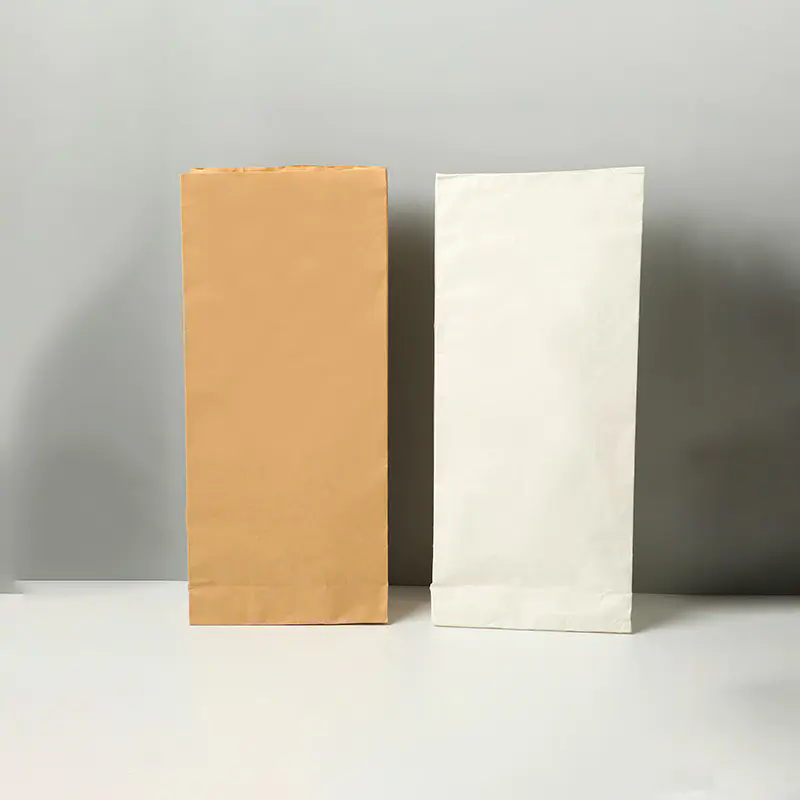
The valve mouth is the defining feature of the Valve Mouth Paper Bag. It is a pre-formed opening at the top or bottom of the bag that allows the filling nozzle to enter and then seals automatically when the nozzle is withdrawn. The sealing is achieved by an internal flap or a series of internal flaps that close under the pressure of the powder. The valve is designed so that the internal pressure of the powder pushes the flaps against the valve opening, creating a tight seal. This self-sealing action is what prevents dust leakage during filling and shipping. The valve also allows for high-speed filling because the nozzle can be inserted and withdrawn quickly without the need for sewing or gluing. The table below shows the typical valve specifications for our gypsum powder bags.
| Valve parameter | Specification | Benefit for gypsum powder |
| Valve type | Internal flap, double-fold | Self-sealing after filling |
| Valve opening diameter | 100 – 150 mm | Compatible with standard filling nozzles |
| Valve seal pressure | 0.02 – 0.05 MPa | Seals under normal internal pressure |
| Valve material | Kraft paper with PE coating | Moisture resistance at the valve |
| Dust leakage rate | < 0.1% of fill weight | Minimal product loss |
In our factory, we test every valve design using a dust leakage test. The bag is filled with gypsum powder, sealed, and then subjected to vibration and handling. The amount of powder that escapes is measured. Our standard valve design achieves a leakage rate of less than 0.1 percent of the fill weight, which is well below the industry acceptable limit of 0.5 percent.
3. What Material Layers Are Used to Protect Gypsum Powder from Moisture?
Moisture protection is achieved through a combination of paper layers and a moisture barrier coating. The standard construction of a Valve Mouth Paper Bag for gypsum powder includes three or four layers of kraft paper, with a PE coating on the inner layer. The PE coating provides the moisture barrier. The outer layers provide the strength and the printing surface. Some bags also include a separate PE liner bag inside the paper bag. The table below shows the typical material construction and the moisture protection performance.
| Layer | Material | Grammage (g/m²) | Function |
| Outer layer | Natural kraft paper | 80 – 90 | Printing surface, tear resistance |
| Middle layer 1 | Natural kraft paper | 80 – 90 | Strength, burst resistance |
| Middle layer 2 | Natural kraft paper | 80 – 90 | Strength, puncture resistance |
| Inner layer | PE coated kraft paper | 80 + 20 PE | Moisture barrier, dust seal |
| Optional liner | PE film bag | 30 – 50 µm | Extra moisture protection |
The water vapor transmission rate (WVTR) of the bag depends on the thickness of the PE coating and the number of paper layers. For a standard 4-layer bag with a 20 g/m² PE coating, the WVTR is approximately 2 to 5 g/m²/day. This is sufficient to protect gypsum powder for up to 6 months in normal warehouse conditions. For longer storage or high-humidity environments, we recommend adding a separate PE liner. Wenzhou Chenxing Packaging Co., Ltd. offers both standard and high-barrier constructions.
4. How Is the Bag Tested to Ensure It Survives Shipping and Handling?
A Valve Mouth Paper Bag must survive the mechanical stresses of filling, palletizing, truck transport, and unloading. The three most important tests are the drop test, the compression test, and the vibration test. The drop test simulates the impact of a bag falling from a pallet or a truck. The compression test measures the stacking strength of the bag. The vibration test simulates the vibration of a truck during transport. The table below shows the test parameters and the acceptance criteria for our gypsum powder bags.
| Test | Test method | Acceptance criteria |
| Drop test | Free fall from 1.2 m, 6 orientations | No rupture, no leakage |
| Compression test | Top load of 800 kg for 24 hours | Deformation < 5%, no rupture |
| Vibration test | Random vibration, 1 hour | No seam failure, no valve leakage |
| Seam strength test | Tensile test on glued seam | > 400 N/50 mm width |
| Valve leakage test | Fill, seal, invert, 24 hours | < 0.1% weight loss |
Field data: A shipment of 20 tons of gypsum powder packed in our Valve Mouth Paper Bag units was transported by truck for 1,200 km over mountain roads. After arrival, the bags were inspected. The leakage rate was less than 0.05 percent, and there was no visible moisture damage. The bags were stacked three layers high on pallets without deformation.
Frequently Asked Questions About Valve Mouth Paper Bags for Gypsum Powder
Summary for Packaging Engineers and Logistics Managers
The Valve Mouth Paper Bag is the preferred packaging solution for gypsum powder because it addresses the four critical damage risks: moisture absorption, bag rupture, dust leakage, and stack collapse. The self-sealing valve prevents dust leakage during filling and shipping. The PE coating provides a moisture barrier. The multi-layer kraft paper construction provides the strength needed for stacking and handling. When selecting a valve mouth paper bag for gypsum powder, verify the valve leakage rate, the WVTR, and the drop test performance. Wenzhou Chenxing Packaging Co., Ltd. has been manufacturing Valve Mouth Paper Bag units for over 15 years and supplies to mineral and construction material producers worldwide.
Wenzhou Chenxing Packaging Co., Ltd. manufactures Valve Mouth Paper Bag units in a range of sizes and material constructions. We provide valve leakage test reports, WVTR data, and drop test results for all of our standard products.
