
How Fast Can a Mouthwash Flat Bottle Labeling Machine Label Bottles Per Minute
2026-11-13
When evaluating packaging equipment for oral care products, speed is one of the first metrics that production managers ask about. The answer depends on machine configuration, bottle geometry, label type, and line integration. At PackSoul, we build Mouthwash Flat Bottle Labeling Machine solutions for brands that need consistent output without sacrificing placement accuracy. This guide breaks down real-world speed ranges, the factors that move them, and how to match a machine to your line.
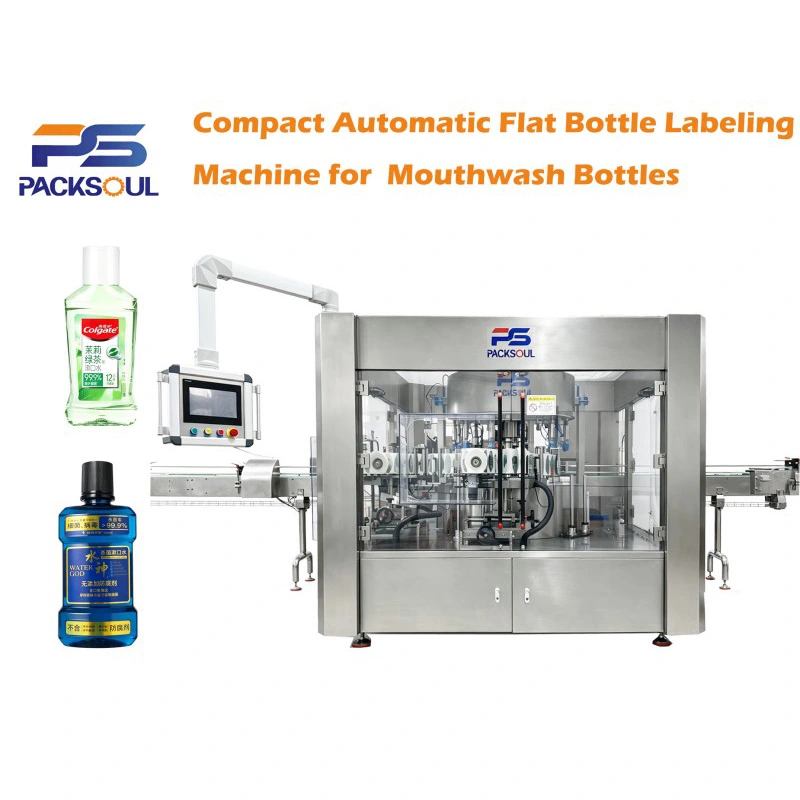
Typical Speed Ranges for a Mouthwash Flat Bottle Labeling Machine
Speed on a Mouthwash Flat Bottle Labeling Machine is usually expressed in bottles per minute (BPM). The table below summarizes common configurations we see across small-batch, mid-volume, and high-speed production environments.
| Machine Configuration | Typical Speed (BPM) | Best Fit |
|---|---|---|
| Semi-automatic flat bottle labeler | 20–40 | Startups, sample runs, low-volume lines |
| Automatic linear labeler (single head) | 40–80 | Mid-volume production, multi-SKU facilities |
| Automatic linear labeler (dual head) | 80–150 | High-volume contract packing |
| Rotary labeling system | 150–300+ | Large-scale, continuous 24/7 operations |
These figures assume standard flat or rectangular mouthwash bottles with self-adhesive labels. Actual throughput can shift based on the variables below.
What Determines Labeling Speed?
-
Bottle shape and stability: Flat bottles with rigid walls feed more predictably than thin or tapered containers.
-
Label size and material: Larger labels require longer dwell and peel times; thin films demand tighter tension control.
-
Conveyor and servo responsiveness: Servo-driven systems from PackSoul maintain speed while correcting minor bottle misalignment.
-
Changeover complexity: Tool-free changeover reduces downtime, which directly affects effective BPM.
-
Upstream and downstream equipment: Capping, filling, and cartoning rates must be balanced with labeling speed.
How to Calculate Effective Throughput
Nameplate speed is not the same as sustained output. Use this formula:
Effective BPM = (60 ÷ cycle time in seconds) × line efficiency factor
A machine rated at 100 BPM running at 85% efficiency delivers roughly 85 BPM over a shift. Planning around effective throughput prevents bottlenecks and overinvestment.
Speed vs. Accuracy Trade-Off
Higher speed is only valuable when placement accuracy holds. On a Mouthwash Flat Bottle Labeling Machine, label placement tolerance of ±1 mm is achievable at mid-to-high speeds with proper servo control and vision inspection. Pushing beyond the machine's design limit typically increases reject rates and rework.
Frequently Asked Questions
Q: Can a Mouthwash Flat Bottle Labeling Machine label both front and back labels in one pass?
A: Yes. Dual-head and rotary configurations can apply front and back labels in a single pass, with independent speed and tension settings for each head. This eliminates a second handling step and typically improves overall line throughput by 20–30%.
Q: What is the maximum speed of a PackSoul Mouthwash Flat Bottle Labeling Machine?
A: PackSoul rotary systems reach up to 300 BPM under controlled conditions, while our automatic linear models cover 40–150 BPM. Final speed is confirmed after a sample run using your actual bottles and labels, so the quoted figure reflects real production performance.
Q: How long does it take to change over a Mouthwash Flat Bottle Labeling Machine between bottle sizes?
A: On PackSoul machines with tool-free adjustment, changeover typically takes 10–20 minutes for bottle height, width, and label position. Machines with stored recipes reduce this further by recalling preset parameters, minimizing downtime between SKUs.
Q: Does labeling speed change with different label materials?
A: Yes. Paper labels generally run faster than thin film labels because they are more stable during peeling. Film labels require reduced acceleration and tighter web tension control, which can lower achievable BPM by 10–15% depending on label size.
Conclusion
Speed on a Mouthwash Flat Bottle Labeling Machine is a system outcome, not a single specification. Matching machine configuration to bottle geometry, label material, and line balance delivers the most reliable BPM. PackSoul supports this process with sample testing, line audits, and configuration guidance.
Contact us today to share your bottle dimensions and target output, and our team will recommend the right Mouthwash Flat Bottle Labeling Machine configuration for your production line.
