
Why Is the Label Fused into an IML Plastic Bucket?
2026-09-21
A label that peels off a plastic bucket is not just an aesthetic problem. It is a traceability failure, a branding failure, and in some cases a regulatory compliance failure. In food service, a missing label can mean an unidentifiable product in a commercial kitchen. In chemical packaging, a peeled label can hide hazard warnings. In cold chain logistics, a faded label can prevent proper inventory tracking. The IML Plastic Bucket solves these problems by fusing the label into the bucket wall during the molding process. The label is not attached to the surface. It becomes part of the surface. This guide explains the technology and why it matters for brands that require durable, tamper-evident labeling.
1. What Happens to an Adhesive Label on a Plastic Bucket in Real Use?
An adhesive label is bonded to the bucket surface by a pressure-sensitive adhesive. The bond depends on three factors: the surface energy of the bucket, the adhesive formulation, and the environmental conditions. In real use, all three factors work against the label. The bucket surface may have mold release agents or surface contamination that reduce adhesion. The adhesive may soften at high temperatures or become brittle at low temperatures. Environmental moisture can migrate under the label edge and lift it. Oil and grease can dissolve the adhesive. The table below shows the typical failure timeline for adhesive labels in different environments.
| Environment | Typical failure mode | Time to failure | Failure consequence |
| Room temperature, dry | Edge lifting | 6 – 12 months | Cosmetic issue |
| Refrigerated (4°C) | Adhesive hardening, edge lifting | 3 – 6 months | Product identification lost |
| Frozen (-18°C) | Adhesive brittle, label falls off | 1 – 3 months | Traceability lost |
| Oily or greasy surface | Adhesive dissolution | 2 – 4 weeks | Hazard warning lost |
| Outdoor, UV exposure | Color fading, adhesive degradation | 2 – 6 months | Brand image damaged |
In our factory, we have tested adhesive labels on standard HDPE buckets in a accelerated aging chamber. The labels began to lift at the edges within 200 hours of humidity exposure. For an IML Plastic Bucket, the label remained intact after 2,000 hours of the same exposure. The difference is not incremental. It is a fundamental difference in how the label is attached.
2. How Does In-Mold Labeling Fuse the Label into the Bucket Wall?
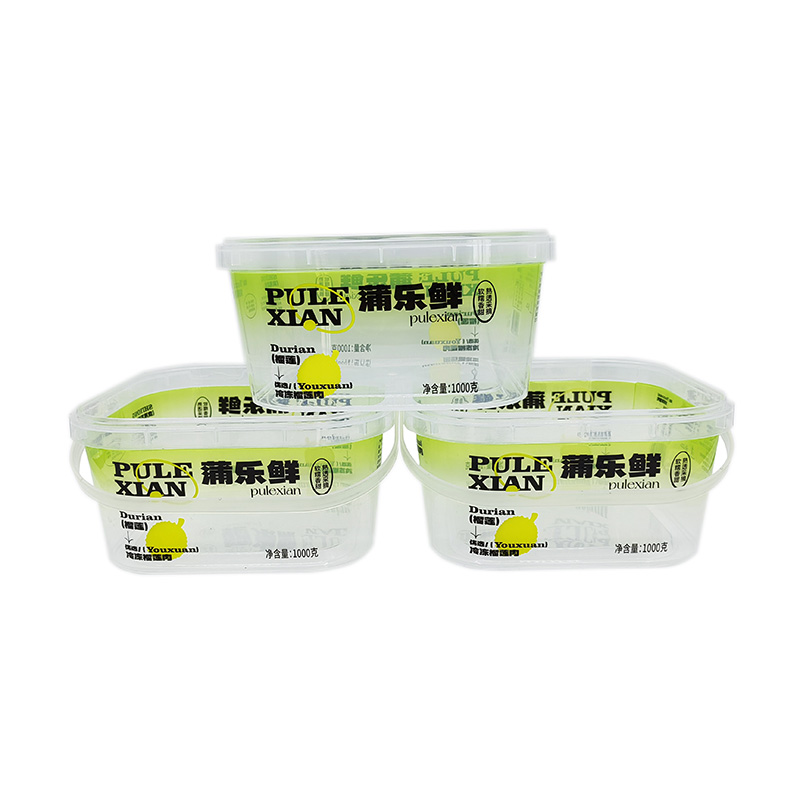
In-mold labeling is a manufacturing process that integrates the label into the plastic part during molding. The process begins with a printed label that is made from the same material as the bucket—typically polypropylene or polyethylene. The label is placed into the mold cavity before the plastic is injected. When the molten plastic enters the mold, it contacts the label and partially melts its surface. The label and the bucket wall fuse together at the molecular level. When the mold opens, the label is embedded in the bucket wall. It is not an adhesive bond. It is a welded bond. The table below compares the bond strength of adhesive labeling and in-mold labeling.
| Bonding method | Bond type | Peel strength (N/25mm) | Failure mode |
| Adhesive label | Pressure-sensitive adhesive | 5 – 15 | Adhesive failure or cohesive failure |
| In-mold label | Thermal fusion | > 50 | Label or substrate tearing (not peeling) |
The peel strength of an IML label is so high that the label cannot be removed without destroying the label or the bucket surface. This provides tamper evidence. If someone tries to remove the label, the damage is visible. Quanzhou Manatee Packaging Technology Co., Ltd. has been manufacturing IML Plastic Bucket products for over 10 years. Our factory uses a robotic label placement system that ensures accurate positioning and consistent fusion.
3. What Are the Additional Benefits of IML Beyond Peel Resistance?
IML labeling offers five additional benefits beyond peel resistance. The first is moisture resistance. Because the label is fused into the bucket wall, there is no edge for moisture to penetrate. The label cannot be affected by water, steam, or condensation. The second is chemical resistance. The label is protected by the same material as the bucket. It resists oils, solvents, and cleaning agents. The third is UV resistance. The label can be printed with UV-stable inks and laminated with a protective layer that prevents fading. The fourth is design flexibility. The label can cover the entire bucket surface, including the bottom and the sides, without seams or overlaps. The fifth is recyclability. Because the label and the bucket are made from the same material, the entire container can be recycled without separating the label. The table below summarizes these benefits.
| Benefit | Adhesive label | IML Plastic Bucket |
| Moisture resistance | Poor (edge penetration) | Excellent (no edges) |
| Chemical resistance | Moderate (adhesive attack) | Excellent (same material) |
| UV resistance | Poor to moderate | Excellent (protected inks) |
| Design coverage | Limited to flat areas | Full 360-degree coverage |
| Recyclability | Requires label removal | No separation required |
The full-coverage design capability is particularly valuable for brands that want to create a seamless, premium look. An IML Plastic Bucket can be printed with high-resolution graphics that wrap around the entire container without a visible label edge. This is not possible with adhesive labels, which always leave a visible edge and a potential starting point for peeling.
4. How Should Brands Specify and Verify IML Bucket Quality?
When specifying an IML Plastic Bucket, brands should require four quality verifications. The first is label fusion. The label should be fully fused to the bucket wall with no visible gaps or bubbles. A cross-section inspection under a microscope can verify the fusion depth. The second is print quality. The print should be sharp and consistent, with no color variation between batches. The third is dimensional accuracy. The bucket should meet the specified dimensions for diameter, height, and wall thickness. The fourth is drop test performance. The bucket should survive a 1.2-meter drop test without cracking or label detachment. In our factory, we perform all four verifications on every production batch and provide the test reports to our customers.
Verification tip: A simple field test for label fusion is the boil test. Immerse the IML Plastic Bucket in boiling water for 10 minutes. An adhesive label will lift or blister. An IML label will remain unchanged. This test can be performed on a sample before placing a production order.
Frequently Asked Questions About IML Plastic Buckets
Summary for Packaging Engineers and Brand Managers
The IML Plastic Bucket solves the durability problems that plague adhesive labels in real-world use. By fusing the label into the bucket wall during molding, it eliminates edge lifting, moisture penetration, chemical attack, and UV fading. It provides full-coverage design freedom and simplifies recycling. The key to a successful IML implementation is to verify label fusion, print quality, dimensional accuracy, and drop test performance. Quanzhou Manatee Packaging Technology Co., Ltd. has been manufacturing IML Plastic Bucket products for over 10 years and supplies to brands in food, chemical, and industrial markets.
Quanzhou Manatee Packaging Technology Co., Ltd. manufactures IML Plastic Bucket products in a range of sizes and configurations. We provide mold design, label printing, injection molding, and quality verification services.
